


AI Prompt & Template Pack for YouTube Growth Review: What You Really Get and Who It’s For
If you’re trying to publish consistently on YouTube, you already know the real bottleneck is not ideas, it’s execution. Research takes time. Scripting takes time. Hooks take time. Titles and thumbnails take time. And once you finally publish, you still need a repeatable system to improve retention, click through rate, and session time.
This is where the AI Prompt & Template Pack for YouTube Growth tries to earn its keep. In this AI Prompt & Template Pack for YouTube Growth Review, I’ll break down what the pack is designed to do, how it fits into a modern YouTube workflow, what it does well, where it can fail, and how to use it in a way that actually moves channel metrics instead of producing generic videos that plateau.
What the AI Prompt & Template Pack for YouTube Growth is supposed to solve
The promise is straightforward: provide ready to use prompts and templates that reduce decision fatigue and speed up your production pipeline. Instead of staring at a blank page, you fill in variables, run a proven prompt, and get a structured output for your next step.
Used correctly, a pack like this can help you:
- Generate video ideas aligned to a niche and audience intent
- Turn ideas into clickable titles and hooks faster
- Build outlines and scripts that follow retention patterns
- Create calls to action that feel natural and convert
- Standardize your content so you can scale output without quality collapse
The value is not that AI can write for you. The value is that you can turn your creative work into a system. Templates turn one good video into a replicable format.
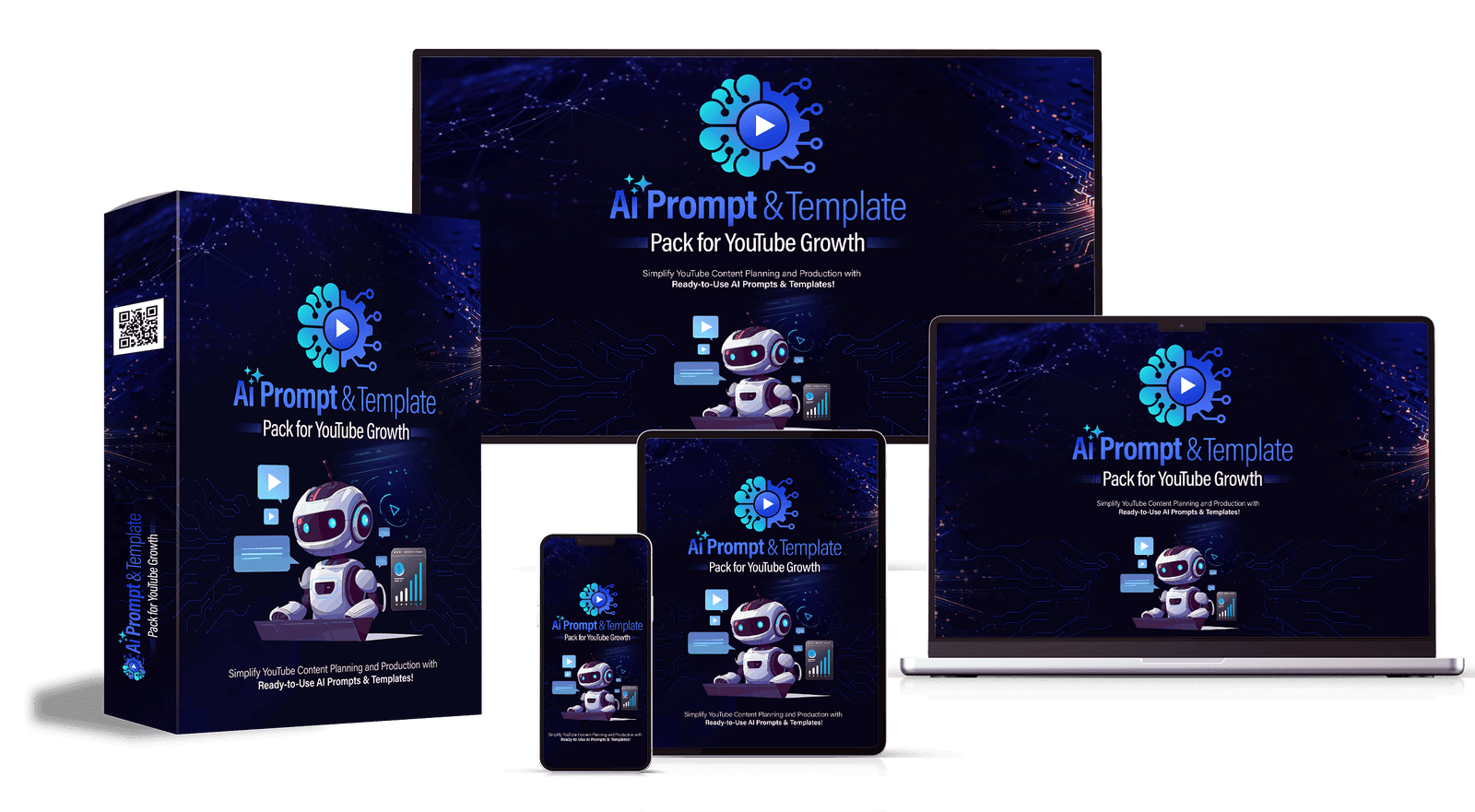
Ready to build a repeatable content system instead of improvising every upload? Get the AI Prompt & Template Pack for YouTube Growth and start producing faster with structured prompts.
Who should consider this pack and who should skip it
Great fit
- New creators who need structure for scripts, hooks, and video packaging
- Busy solo creators who must ship content while balancing a job or business
- Faceless channel builders who rely on consistent production and standardized formats
- Agencies and editors who want repeatable briefs and scripting frameworks
- Marketers using YouTube as top of funnel for products or services
Not a good fit
- Creators who refuse templates and only want fully bespoke storytelling each time
- Channels with an established writers room and a mature internal SOP already
- Anyone expecting one click virality, because prompts do not replace niche knowledge or on camera performance
What’s typically inside an AI prompt and template pack like this
Offer pages often summarize it broadly, but the underlying structure of these packs usually includes multiple categories of prompts and fill in templates. The best packs cover the entire lifecycle, not just script generation.
Here’s what you should expect a comprehensive AI Prompt & Template Pack for YouTube Growth to enable, from strategy to post publish iteration.
1) Channel and niche positioning prompts
Growth becomes easier when your channel has a tight identity. The strongest prompt packs include templates that force you to define:
- Audience persona and pain points
- Unique angle and channel promise
- Content pillars and series formats
- Competitive differentiation and topic white space
If you skip this step, AI outputs become generic and interchangeable. YouTube then treats your content as replaceable, and your audience does too.
2) Idea generation prompts that map to intent
Ideas are cheap. High intent ideas are rare. A useful prompt pack will help you create:
- Search driven topics with clear keywords and problem statements
- Suggested browse topics built around curiosity and trend adjacency
- Series ideas with escalating difficulty or depth
- Topic clusters that build topical authority over time
The best way to use these prompts is to add your own constraints: target audience sophistication, video length, content pillar, and your unique perspective.
3) Titles and hooks that compete
YouTube is a packaging platform. Great content with weak packaging dies quietly. Packs like this often provide:
- Title formulas for different niches
- Hook templates for the first 15 seconds
- Open loops and pattern interrupts
- Promise and payoff structures
What matters is not hype. It’s clarity plus curiosity. Your title and hook must create a single clean question in the viewer’s mind.
4) Outline and scripting templates
This is usually the core of the product. Script templates help you avoid rambling and front load value. Typical frameworks include:
- Problem, proof, plan, payoff
- Myth, mistake, method
- Step by step tutorial flows
- Story arcs for case studies
- List video pacing templates that keep momentum
When you combine a script template with your own examples, you get speed and originality at the same time.
5) Engagement and conversion prompts
Growth is not only views. It’s retention, returning viewers, subscribers, and revenue. Prompt packs often include templates for:
- Mid video engagement questions
- Subscribe calls that do not feel desperate
- End screen setups and next video bridges
- Community post ideas and pinned comment prompts
6) Repurposing templates
Once you have a strong long form video, you can create multiple outputs:
- Shorts scripts and hooks from a long form transcript
- LinkedIn or X threads
- Email newsletter summaries
- Blog post outlines
This is where the system starts compounding. One good video becomes ten distribution assets.
My hands on take: where this kind of pack creates real leverage
In any AI Prompt & Template Pack for YouTube Growth Review, the key question is simple: does it reduce time to publish without reducing quality? In practice, prompt packs can create leverage in three places.
Leverage point 1: removing blank page friction
Most creators waste time not on writing, but on starting. A template gives you a first move. That first move is often all you need to get into flow.
Leverage point 2: standardizing quality control
When your workflow is template driven, your baseline improves. You stop forgetting essentials like:
- Clear promise in the intro
- Strong structure with segments
- Frequent re hooks that reset attention
- A tangible payoff at the end
Leverage point 3: building a scalable production pipeline
If you publish once a month, you can afford perfectionism. If you publish two to five times a week, you need a system. Templates give you a factory model while still leaving room for personality, examples, and editing style.
The brutal flaws: where prompt packs often disappoint
The title of this article is intentionally honest. Prompt packs can help, but they are not magic. Here are the failure modes I see most often, and how to avoid them.
Flaw 1: generic outputs if you do not feed real inputs
AI gives you average results when you provide average prompts. Even if the pack includes strong templates, you still must add:
- Your niche and sub niche specificity
- Audience pain points in their own words
- Your personal experience or data
- Examples, anecdotes, and constraints
Flaw 2: scripts that read like scripts
Many AI scripts have a certain cadence that viewers can feel. The fix is simple: rewrite for your voice. Shorten sentences. Add imperfections. Add real opinions. Add stakes.
Flaw 3: over templating can kill originality
If every video follows the same flow, your audience predicts the beats. Use templates as scaffolding, not as a prison. Swap segments. Change pacing. Insert unexpected mini stories.
Flaw 4: prompts do not fix weak packaging execution
A great title prompt does not automatically produce a great title for your channel. You still need taste and testing. A thumbnail prompt does not replace design skills. The pack can help you brief a designer, but you still must choose what to ship.
How to use the AI Prompt & Template Pack for YouTube Growth without sounding like everyone else
The difference between creators who win with templates and creators who blend in is customization. Here is a practical workflow you can run every week.
Step 1: Create a channel voice card
Write a short document you reuse in every prompt:
- Target audience and sophistication level
- Voice adjectives like direct, witty, calm, contrarian
- Words you avoid and words you prefer
- Allowed claims and required proof style
Attach this voice card to every prompt you run. It will reduce generic phrasing instantly.
Step 2: Use the idea prompts to generate clusters, not random topics
Instead of making ten unrelated videos, build clusters. Example:
- One pillar: YouTube scripting
- Three supporting topics: hooks, pacing, storytelling
- Three levels: beginner, intermediate, advanced
This increases binge watching and returning viewers because each video naturally leads to another.
Step 3: Write the script in layers
Template first, then depth. Run prompts in this order:
- Outline prompt
- Hook prompt that matches the outline promise
- Section by section expansion prompts
- Retention polish prompt to remove fluff
- CTA prompt that matches your offer and audience stage
This prevents the common problem of letting AI generate a long script that you later have to untangle.
Step 4: Add proof and specificity
Before recording, add at least three proof elements:
- A personal story or failure
- A specific example with numbers
- A demonstration, screen recording, or before after
Your viewer should feel like they cannot get this video from anyone else.
Real use cases: where this pack is especially useful
Below are practical scenarios where a structured AI Prompt & Template Pack for YouTube Growth can save hours while improving consistency.
Use case 1: faceless channels and narration workflows
Faceless channels often need high output. With scripting templates you can build repeatable formats like:
- Explainers that start with a surprising claim and then prove it
- List videos with consistent segment timing
- Case study breakdowns with a lesson at the end
Because you are not relying on personality as the main hook, structure matters even more.
Use case 2: experts who struggle to simplify
Experts often over teach. The pack’s templates can force clarity: define the viewer’s starting point, define one outcome, and cut anything that does not serve it.
Use case 3: product driven channels
If you sell software, courses, coaching, or services, YouTube can be your best trust engine. Templates can help you create:
- Problem led educational videos
- Comparison videos that pre qualify buyers
- Implementation tutorials that reduce churn0
If you want a faster way to plan, script, and publish without losing consistency, grab the AI Prompt & Template Pack for YouTube Growth and turn your next upload into a repeatable template.
What to look for in quality prompts and templates
Not all prompt packs are created equal. Here are criteria that separate high value packs from collections of random prompts.

Clear variables and placeholders
Good templates include fields like:
- Niche
- Viewer avatar
- Main promise
- Contrarian angle
- Proof assets
- Desired length and tone
When variables are explicit, you can delegate work and maintain consistency across a team.
Output constraints
Strong prompts limit the output: word count per section, number of bullets, number of examples, and the exact structure. This reduces fluff and improves pacing.
Retention aware structure
The best templates assume viewers are impatient. They front load value, avoid long intros, and include re hooks that reset attention every 20 to 40 seconds.
Revision prompts
Most creators only use generative prompts. The best packs also include editing prompts such as:
- Remove redundancy and tighten sentences
- Rewrite for punchier cadence
- Replace generic phrases with specific examples
- Increase curiosity without clickbait
How this fits into a full YouTube growth system
A prompt pack is one tool. For real channel growth, you need the entire loop:
- Research to understand audience, competitors, and topic demand
- Packaging to win the click with title and thumbnail
- Retention to keep viewers watching
- Session to lead viewers to the next video
- Iteration to improve based on analytics
The pack contributes mainly to research speed, scripting quality, and retention structure. It does not replace analytics. It does not replace thumbnail testing. But it can drastically shorten the time between insight and execution.
Analytics prompts you should run after publishing
Even if your pack focuses on creation, you can use similar prompts to review performance. Feed your audience retention graph notes into AI and ask for:
- Likely drop off causes in the first 30 seconds
- Segments that could be tightened
- Alternate hooks for the same video concept
- New follow up video ideas based on top comments
This is where improvement becomes systematic instead of emotional.
Pricing value: when it’s worth paying for templates
Some creators hesitate to buy prompt packs because they assume they can write prompts themselves. You can, but the real cost is time. What you are buying is:
- Someone else’s tested structure
- A faster starting point
- A library you can reuse for months
If the pack saves you even one to two hours per script, it can pay for itself quickly, especially if YouTube is tied to revenue.
How to implement in the next 48 hours
If you want momentum, avoid the trap of reading and organizing forever. Here’s an execution plan you can do immediately.
Day 1: Build a mini content calendar
- Choose one content pillar
- Generate ten topic ideas with the idea prompts
- Select three based on clarity and demand
- Create one series title that connects them
Day 2: Produce one video with the full template stack
- Create title options and pick the clearest promise
- Write a hook that matches the title exactly
- Outline with a template and add your proof elements
- Write the script section by section
- End with a bridge to your next video
Once you have one strong workflow, you can repeat it weekly and improve with analytics.
Final verdict in this AI Prompt & Template Pack for YouTube Growth Review
The AI Prompt & Template Pack for YouTube Growth is most valuable for creators who want speed with structure. Its best use is not to outsource your thinking, but to standardize your thinking so you can ship consistently and improve faster.
The upside is real if you treat it like a system: define your voice, feed specific inputs, and use templates to build repeatable series. The downside is also real if you rely on default outputs and publish generic scripts without proof, personality, or packaging polish.
If your goal is to post more often while improving retention and clarity, this type of pack can be a practical shortcut.
Want the fastest path from idea to script to publish ready structure? Access the AI Prompt & Template Pack for YouTube Growth and start building videos that feel consistent, clear, and scalable.
👉 See more related articles here: Kidstudio AI Review: 9 Powerful Wins and Brutal Flaws